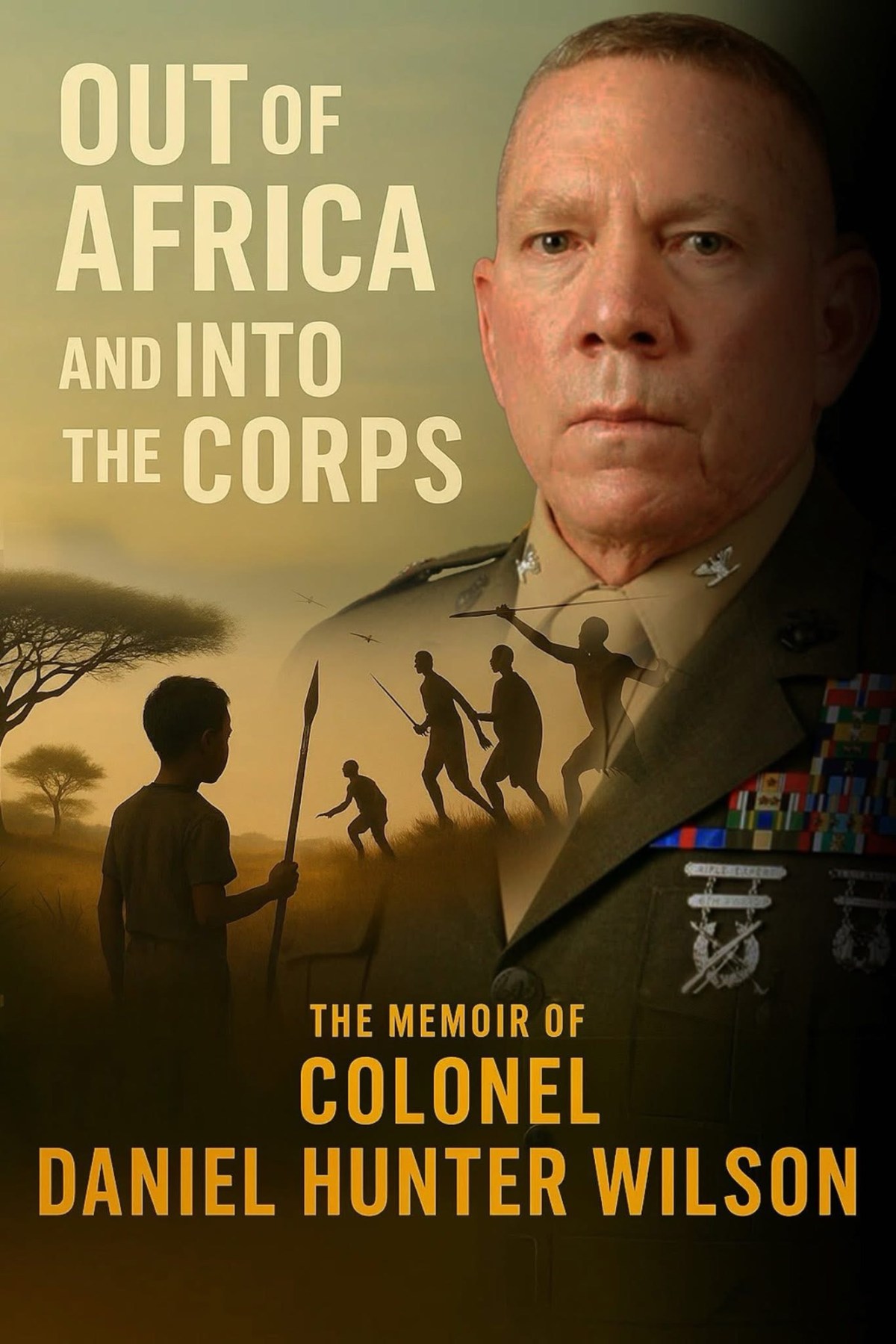
Rarely can defeat of an occupation force be accomplished solely by air power. Desert Storm required ground troops (aka: Grunts) to invade Kuwait and kick the occupying Iraqi forces out. Air power, beginning on 17 January 1991 had “softened” them up, but “boots on the ground” were required to deliver the “coup de gras.” We did, and in short order. I was the Heavy Machine Gun Platoon Commander (aka: Rat Patrol) of 1st Battalion, 5th Marines, Task Force Ripper, 1st Marine Division. Task Force Ripper was the “Main Effort” for 1st Marine Division and was comprised of two infantry battalions, moving north from Saudi Arabia into Kuwait. My battalion, 1/5, and 1st Battalion, 7th Marines, commanded by Lieutenant Colonel “Mad Dog” Mattis. I literally fought Desert Storm side-by-side with the legendary “Mad Dog” (aka: Callsign Chaos)! “Hi diddle diddle, straight up the middle!”
Here is an excerpt from my book, OUT OF AFRICA AND INTO THE CORPS:
“In the wee hours of 24 February 1991, and right on schedule, Heavy Machine Gun Platoon started moving towards our attack positions about a mile shy of the first obstacle belt with our battalion following in trace, right behind us. Charlie Company led the battalion, and several times I got a radio call from Captain Coia, their company commander. “Mustang, this is Bladerunner, over.” “Bladerunner, this is Mustang, over.” “Yeah, Mustang, you’re getting too far ahead of me, could you slow down a bit?” “Roger that, Bladerunner.” I would then inform my section leaders on my platoon’s radio net to slow down a bit. They were already tracking, because they were monitoring the battalion’s tactical net as well. It was about 0400 when we got into our attack positions and waited for the order to commence the attack. Shortly after daylight, the tank company attached to our battalion opened up fire on what they thought were enemy targets. I immediately assessed that they were firing at friendly forces. I tried to get ahold of their commander on the battalion’s tactical net. I couldn’t because he was directing fires on his company’s internal net and not monitoring the battalion tactical net. I immediately called to our battalion’s Operations Officer, Major Lockhart, to report what I suspected were the tanks firing at friendlies. “Dealer this is Mustang, over.” “Mustang, Dealer, go.” “Dealer, looks like our tanks are firing towards Task Force Grizzly.” Seconds later, Dealer makes an emergency announcement over the battalion tactical net. “Cease fire, cease fire, cease fire…all units immediately cease fire!” Unfortunately, the tank company was not monitoring the battalion tactical net, as they were on their company net, still directing fires on what they thought were enemy targets. I got on my internal platoon radio net and ordered my Marines out of their vehicles and told them to go bang on the hatches of the tanks, get their attention and tell them to “cease fire!” My Marines did as I ordered, but it still took several more minutes to get all the tanks to cease firing. They had fired several tank rounds into Task Force Grizzly’s zone, or area of operations, which was on the left flank of Task Force Ripper. One tank round was a direct hit on a Marine 5-ton truck in which four Marines of Lieutenant Max Galeai’s platoon were instantly killed and several others wounded. I could not believe that we already had casualties before even commencing the actual attack into Kuwait. It may have been worse, had not my Marines gone around to each of the tanks and told them to “cease fire.” This was the second major “friendly fire” incident of Desert Storm. First Light Armored Reconnaissance Battalion had been engaging an Iraqi force of approximately 50 tanks and armored personnel carriers south of the Kuwaiti town of al-Wafra on 29 January 1991. An A-10 Thunderbolt of the U.S. Air Force, mistaking the Marine unit for an Iraqi unit, fired a Maverick missile that struck one of our Marine Light Armored Reconnaissance Vehicles, killing seven Marines and wounding the others in the vehicle. We commenced the attack, shortly after the unfortunate friendly fire incident. My platoon moved up smartly to within two hundred meters of the first obstacle belt and established overwatch positions to provide security for our Battalion’s Engineer Detachment, led by Lieutenant Wayne Sinclair. We were taking no fire from the Iraqi side of the obstacle belt, as expected, because our intelligence analysts had assessed that all Iraqi troops had abandoned their positions on the first obstacle belt and had retreated behind the second obstacle belt, approximately ten miles to our north. We had rehearsed the obstacle belt breaching procedure numerous times in the months leading up to this moment and it went off like clockwork. The engineers brought up an Amphibious Assault Vehicle that was specially equipped to fire a mine clearing line charge (MICLIC). It is long, thin, and packed with C4 explosives. When detonated, it blows up everything in its path, creating a lane approximately eight feet wide by 350 feet in length. If there are subsurface mines, the over-pressure will detonate them down to a certain depth. The engineers had deployed a single line charge and blown it in under five minutes. They next brought up their specially built mine plough, which quickly plowed through the lane. Finally, a mine-roller went over the lane to flatten the surface and detonate any remaining mines or improvised explosive devices (IEDs). With the breaching lane cleared “hot,” I ordered two of my sections to the far side of the first obstacle belt to provide overwatch security, as the remainder of the battalion punched through. I went through with them and noted that there were a few fake Iraqi tanks on the far side along with a couple of smoldering tank hulks. The fake tanks had been built with plywood and painted to look like real tanks. They were so crude and ridiculous that I chuckled when I saw them. What Sadaam had called an “impenetrable” obstacle belt had been breached in under an hour. After our battalion was through, my platoon resumed our positions at the head of the battalion, leading the way to the second obstacle belt. We were half way there when we began to take artillery and mortar fire. Suddenly, Blackjack, the Battalion Commander ordered a halt. We became sitting ducks, and I was expecting to take direct hits any second. I called back to our Operations Officer, Dealer, to enquire as to the reason for the halt. He never responded directly, just telling me to hold in place. I could only surmise that Blackjack had gotten cold feet, after we started taking indirect fires from the Iraqi’s and decided to halt in order to figure out what to do. We all knew that halting was not the best thing to do. In fact, it was the worst thing to do. Continuing to move forward against our next objective, the second obstacle belt, was the right thing to do. Moving targets are much harder to hit than stationary targets. Finally, after what seemed like hours, but was about thirty minutes, we were ordered to resume the attack. Shortly after resuming the attack, an artillery round exploded close to Sergeant Jenkin’s Humvee. His gunner, Lance Corporal Art Windsor, who was in the turret, manning his .50 caliber machine gun, was wounded by shrapnel in his hand. I ordered Gunny Miles, our Platoon Sergeant to evacuate Lance Corporal Windsor back to the mobile Battalion Aid Station. Meanwhile, we continued to press forward as all this was taking place. As my platoon approached to within a mile of the second obstacle belt, we started taking direct fire from the Iraqi troops, manning their positions at the second obstacle belt. I ordered my platoon to open fire on enemy targets. We were firing on the move as we continued to close in on the second obstacle belt. Suddenly, my lead section spotted white flags going up from the second obstacle belt. Upon receiving the report, I ordered a “cease fire.” My guys stopped firing as we continued to approach the Iraqi positions. It turned out that the second obstacle belt was just a line of Iraqi fighting positions. The Iraqi troops were exiting their fighting positions and lining up in a formation behind them. My Marines were going through their crudely built fighting positions to ensure they were cleared. They asked me what to do with the dead bodies. I told them that we had to leave them for follow-on forces, because we were now going to be leading our battalion’s attack on our third objective, the airfield called Al Jaber, just three miles away. My guys went through the large formation of Iraqi troops to make sure they were disarmed, and I ordered them in Arabic to remain in place…that our follow-on forces would process them. My platoon then proceeded to lead our battalion to the airfield and Blade Runner was given the order by Dealer to clear the East side. Marines from 2nd Marine Division were clearing the other side of the airfield. It was dark when Charlie Company accomplished their mission with only a few sporadic fire fights at the airfield. Dealer ordered me to continue leading the march to the north. We moved away from the airfield, but then were ordered to halt, while the rest of the battalion caught up to us. Night descended on us like a thick, heavy, blanket. It was a total blackout, the likes of which I had never experienced. Thick, dark, noxious, black, oily, smoke had enveloped us. The smoke was from the oil well fires, which the Iraqi troops had started at the beginning of the air campaign. Visibility was zero. I could not see my hand six inches away from my face. At one point, I needed to take a leak and exited my Humvee to pee. I only went about ten feet from my vehicle, but when I was done, I could not see anything and became disoriented. I finally dropped down to my hands and knees and crawled in the direction of my Humvee until I bumped into it. I got back into my Humvee in time to hear from Dealer to go to MOPP Level 4…that Mustard Gas had been detected. Our battalion had a special vehicle that was equipped with sensors to detect chemical and biological substances in the environment. This vehicle had detected Mustard Gas, likely from one of the artillery rounds being fired in our direction by the Iraqi troops. After I put my gas mask on, I felt a distinct burning sensation on the back of my neck, consistent with exposure to Mustard Gas. The Germans had used it against American troops, during trench warfare in World War I. It wasn’t until two hours later that we got the “all clear” signal and were able to at least remove our gas masks. Military gas masks are very uncomfortable and make communication extremely difficult. The person who invents a gas mask that is even marginally better than the one currently used, could become a millionaire overnight, provided the military buys it. Our battalion spent the night there, but we were too hyped up to get any sleep. I was thankful to have my stash of Copenhagen. The fresh hits of nicotine keep me awake and alert. It’s hard to get any sleep when random artillery rounds are exploding nearby, and your mind is wondering if you’re going to be the next victim. I promised God that if He kept me safe, I would endeavor to be a better man for the rest of my life…Dan 2.0.”
May those who gave the ultimate sacrifice in Desert Storm “Rest in Eternal Peace.” For “all gave some, and some gave ALL!”
Semper Fi…Colonel Daniel Hunter Wilson…Retired Marine
 A 110 PERCENT MENTALITY-THE COLONEL'S CORNER