Easy Book Order

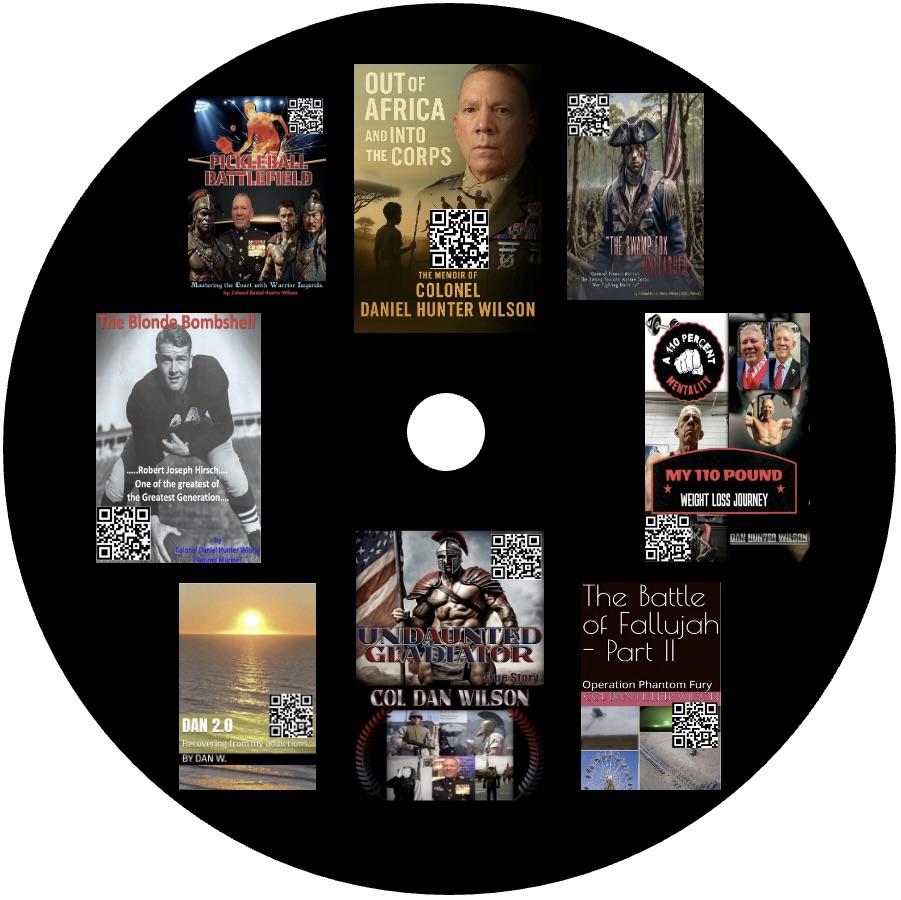
Eight books by retired Marine Colonel, Dan Wilson.

Here’s an easy way to order any of my eight books.

Point your smart phone camera at the embedded QR code, which takes you straight to the book on Amazon, which can be ordered in any of four formats: Hardcover, Paperback, Audio Book, and Kindle/Ebook versions.

I’m having a car cover made up as my guerrilla marketing idea!

Car Cover Idea
UNDAUNTED GLADIATOR
OUT OF AFRICA AND INTO THE CORPS
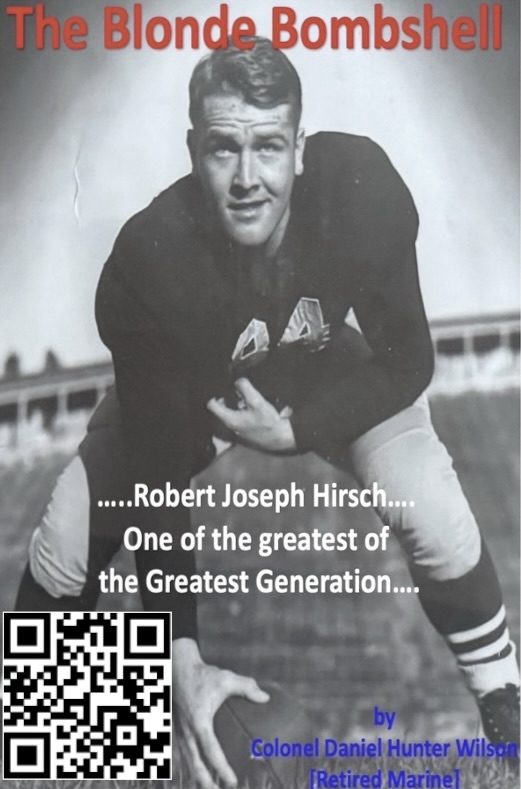
THE BLONDE BOMBSHELL
A 110 PERCENT MENTALITY
PICKLEBALL BATTLEFIELD
THE SWAMP FOX UNLEASHED
DAN 2.0
THE BATTLE OF FALLUJAH – PART II

Pickleball Immortality!

Pickleball players live longer according to scientists! My opinion is that the better a Pickleball player you are, the longer you live, but I’m not a scientist and I didn’t play one on TV…LOL!

Pickleball Longevity!

If you want to get better at Pickleball, and live longer, why not read my book, PICKLEBALL BATTLEFIELD, or have me read it to you! Click on the link in the caption to order your copy now and live longer!

https://a.co/d/03XEoffa

UNDAUNTED GLADIATOR: Colonel Dan Wilson’s Epic Fight for Justice After False Accusations Shattered a Legendary Marine Career

In Undaunted Gladiator, Colonel Dan Wilson recounts his epic fight for justice after false accusations shattered his distinguished Marine career, revealing shocking flaws in the military justice system and the power of unwavering faith.

Imagine a battle-hardened Marine Colonel—39 years of service, 11 deployments, Bronze Star, Legion of Merit, three Meritorious Service Medals, two Combat Action Ribbons, and a life forged in the crucible of Africa’s wilds and Iraq’s fiercest firefights—falsely accused of raping a child at a simple dinner party. Relieved of duties, dragged through a 14-month “witch hunt,” thrown into pretrial confinement, convicted in a politically charged court-martial, and locked away in the brig for 33 brutal months. That’s not fiction. That’s the jaw-dropping true story at the heart of Undaunted Gladiator by Colonel Dan Wilson.

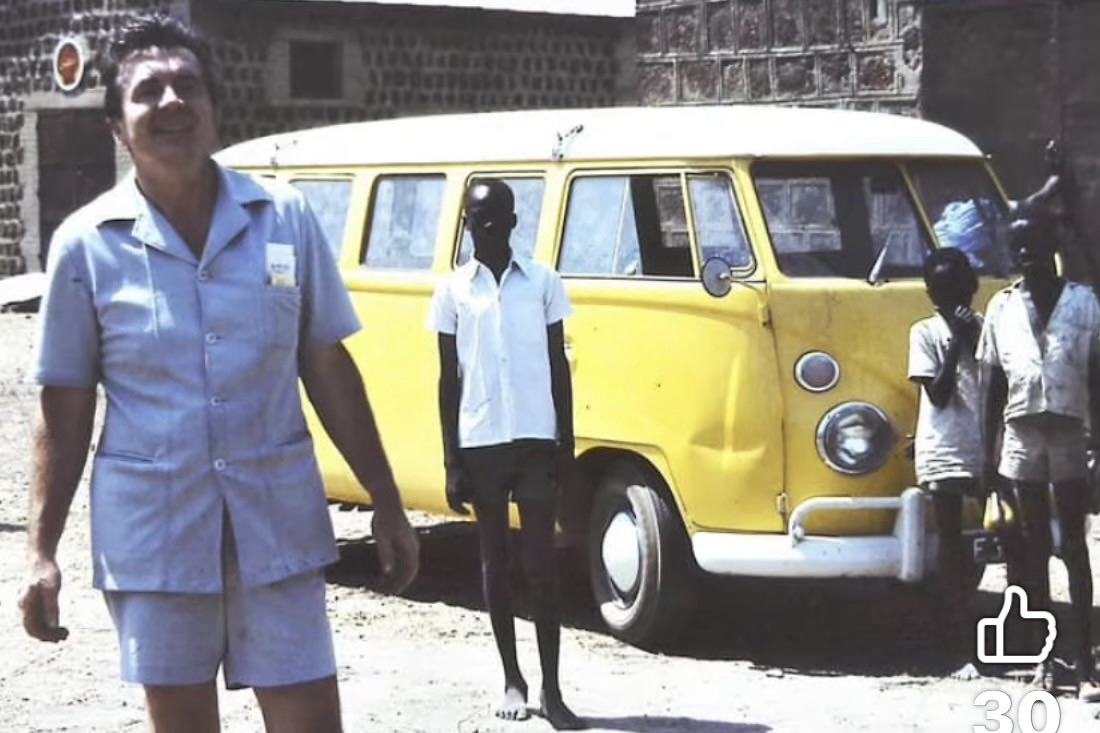
From his missionary childhood in Sudan, Kenya, South Africa and Namibia—learning to track game with Bushmen, speaking seven languages, and climbing Mt. Kilimanjaro at 14—Wilson was destined for the Corps. He enlisted in 1981, graduated Boot Camp as Platoon and Series Honor Man, earned meritorious promotions to Sergeant in just 16 months, and rose as a “Mustang” infantry officer. He commanded four platoons, three companies, and four battalions; fought in Desert Storm and the Second Battle of Fallujah; briefed generals in the Pentagon; and served as G-3 Operations Officer for II MEF. Decorated 52 times, he lived the Marine ethos: “Semper Fi” wasn’t a slogan—it was his heartbeat.

Then came the dinner party implosion on 13 July 2016. A junior officer’s wife accused him of inappropriately touching her six-year-old daughter. NCIS launched a global fishing expedition, storming his home several times, interrogating his terrified wife, and stacking 27 charges. A second accuser emerged months later with her own wild claims. Wilson was relieved of duties, confined for seven months pretrial, and ultimately convicted on the child sexual abuse charge plus lesser misconduct counts. Sentenced to five-and-a-half years, he entered the brig wearing orange, Prisoner #00128660 Whisky Delta—Cell #13.

What follows is pure fire. Wilson doesn’t break—he rises. He finds God in the darkness (“be like that tree!”), turns to daily prayer and meditation, forges unbreakable bonds with fellow prisoners (the “finest Marines I ever served with”), and watches his brilliant civilian appellate lawyer, Katie Cherkasky, dismantle the case. On 1 July 2019, the Navy-Marine Corps Court of Criminal Appeals delivers a stunning unanimous reversal, and rebuke to the generals who convicted him—“set aside with prejudice”—the rarest of victories. A double rainbow appears over Camp Pendleton that same weekend. Divine confirmation.

Yet the system wasn’t done. Wilson signs a “dirty deal” under duress for release: voluntary retirement in exchange for “no punishment.” The convening authority reneges. He’s retired in the pay of a Lieutenant Colonel with an “Other-Than-Honorable” characterization of his very honorable service—losing $5,000+ monthly in benefits for life, banned from all Marine Corps bases for life. The very policies meant to protect victims weaponized against an innocent warrior.

Undaunted Gladiator isn’t just a memoir—it’s a clarion call. Wilson exposes how #MeToo zeal, unlawful command influence, and a “believe the female accuser at all costs” culture have corrupted military justice. He names the rot: NCIS overreach, stacked charges, biased panels, and careerist generals protecting the institution over truth. But he also shows the light—unshakable faith in God, family loyalty (his wife and daughters earn “Medals of Honor”). Post-release, he lives the “Life of Riley” in Myrtle Beach—writing, mentoring, working out, and playing Pickleball daily. He has published eight books, produced a music album and is working on finishing up three more books.

Wilson’s message rings eternal: “Everything happens for a reason.” His Higher Power whom he calls God, guided him through hell to emerge stronger, calling readers to demand reform so no other patriot suffers the same fate. Raw, riveting, and redemptive, this book will leave you furious at the system, inspired by the man, and moved to tears by the love that carried him.

If you believe in truth, justice, and the Marine Corps we all swore to defend—read Undaunted Gladiator. Buy it. Share it. Join the fight to fix what’s broken. Semper Fi, Colonel. Your story isn’t over—it’s just beginning.

https://a.co/d/09C79nxI

DAN 2.0…my story of recovering from Alcohol, Nicotine & Caffeine

How I am recovering from alcoholism and my addictions.

I’m a late bloomer. It took retiring from the Marines, after nearly 39 years on active duty, to embrace a recovery program and stop using alcohol, nicotine, and caffeine. I was 60 years old.

I was inspired at the four-year mark to write down my story in order to share my experience, strength and hope with others who might be inspired to quit any addiction that might haunting them. The insanity of it all!

In the tradition of Bill Wilson, the co-founder of Alcoholics Anonymous, I decided to have the book authored by Dan W., given Bill wrote a book by Bill W. In the book, I candidly describe how I am recovering from the addictions of alcohol, nicotine, and caffeine. I say recovering specifically because I firmly believe that I will have the disease of alcoholism for the rest of my life. The second that I proclaim myself “recovered,” I believe that it will only be a matter of time before I start drinking alcohol again. “Complacency kills!” I view my sobriety as a temporary reprieve, and that my continued sobriety is contingent upon my spiritual condition. Therefore, I must put prioritize my spiritual growth every single day in order to stay away from that next drink. I take it one day at a time and today marks 1885 days of continuous sobriety…five years and two months exactly. I’m very thankful to my Higher Power, whom I choose to call God, for His grace and mercy and gifting me the miracle of sobriety for the longest period ever in my adult life.I sincerely hope that if you are able to read my story that you are inspired to commence a recovery journey of your own. I pray that you are one of the chosen ones afflicted with alcoholism, or addiction, and that recovery rockets you into the fourth dimension of living that you may live a life of serenity; happy, joyous, and free. These past five years have been the most awesome years of my life. I pray the same for you.

Here is my book and the link allows you to buy it straight from Amazon in any of four formats. If you do happen to read it, I’d certainly appreciate a review. Thank you, and may your recovery journey be slow. Enjoy the journey!

https://a.co/d/03pLaxE4

PICKLEBALL BATTLEFIELD…A Seminal Book on Pickleball Strategy

A must read for all Pickleball players at any level. This book WILL improve your game!

“Pickleball Battlefield: Mastering the Court with Warrior Legends” by Colonel Daniel Hunter Wilson is a groundbreaking fusion of military strategy and paddle sport genius. Drawing from legends like Shaka Zulu, Sun Tzu, and Chesty Puller, Wilson—a retired Marine infantry officer with nearly four decades of active duty experience—transforms Pickleball into a strategic battlefield.

Each chapter distills warrior wisdom into actionable tips: envelop opponents like Zulu horns, deceive like Sun Tzu, or charge relentlessly like Patton.

Humorous, insightful, and packed with personal anecdotes from Wilson’s African childhood to Iraq deployments, this book elevates your game while entertaining.

A must-read for warriors at heart. You will definitely improve your Pickleball game after reading the good Colonel’s book, whatever level player you are! Perfect for enthusiasts seeking an edge with a wink—Semper Fi on the court!

https://a.co/d/04SxspZO

UNBROKEN: A Testament to the Indomitable Human Spirit

Hey there, fellow book lovers! If you’re anything like me, you occasionally stumble upon a story that doesn’t just entertain you—it reshapes how you view the world. That’s exactly what happened when I dove into Unbroken: A World War II Story of Survival, Resilience, and Redemption by Laura Hillenbrand. This isn’t just a book; it’s a raw, unflinching chronicle of one man’s extraordinary journey through hell and back. It is the ultimate example of human resilience!

Louis Zamperini’s life story is a masterclass in what it means to endure, adapt, and ultimately triumph. He exemplified what all of us Marines are taught by our Drill Instructors: “adapt, improvise and overcome!”

Unbroken follows the life of Louis Zamperini, a mischievous kid from California who channels his rebellious energy into becoming a world-class Olympic runner in the 1936 Berlin Games. But that’s just the setup. When World War II erupts, Zamperini’s path takes a dramatic turn into the Pacific theater, where he’s thrust into unimaginable trials: a harrowing plane crash, weeks adrift at sea facing starvation and sharks, and then the brutal realities of Japanese POW camps.

Hillenbrand, the same author behind Seabiscuit, weaves this narrative with meticulous research and vivid prose. She draws from interviews, diaries, and historical records to paint a picture that’s as historically accurate as it is emotionally charged. It’s not just a biography; it’s a pulse-pounding adventure that reads like a thriller, with themes of forgiveness, faith, and redemption threading through the chaos.

Zamperini isn’t a superhero—he’s flawed, impulsive, and very human. Yet, in the face of relentless physical and psychological torment, he clings to his dignity and will to survive. Hillenbrand doesn’t sugarcoat the horrors: the beatings, the deprivation, the mental breakdowns. But it’s through these that we see resilience in its purest form—not as some abstract ideal, but as a gritty, day-by-day choice to keep going.

What struck me most is how the book explores resilience beyond mere survival. It’s about rebuilding after the war, confronting PTSD (though it wasn’t called that back then), and finding peace. Zamperini’s story reminds us that true strength often emerges from our darkest moments. In a world where we all face our own battles—be it personal loss, health struggles, or everyday stresses—Unbroken is a beacon. It shows that resilience isn’t about being unbreakable; it’s about piecing yourself back together when you shatter. A real-world Humpty Dumpty story of putting yourself back together with God’s spirit: “I can do all things through Christ who strengthens me!”

Hillenbrand’s writing elevates this even further. Her attention to detail brings the era to life—the roar of bomber engines, the sting of saltwater, the quiet moments of camaraderie amid despair. If you’ve ever wondered how ordinary people rise to extraordinary challenges, this book answers it with unflinching honesty.

If you’re into history, biographies, or stories of triumph over adversity, Unbroken is a must. It’s perfect for fans of books like The Boys in the Boat or Band of Brothers. Even if WWII isn’t your usual jam, the universal themes make it accessible and inspiring. Just a heads up: it’s intense, so brace yourself for some tough scenes—but the payoff is worth it.

Unbroken left me in awe of the human capacity for endurance and forgiveness. It’s one of those rare reads that sticks with you long after the last page, urging you to reflect on your own resilience.

This book was a huge inspiration to me when I read it as a full bird Colonel on Parris Island. I highly recommend it to everyone!

Why “Adventures of Huckleberry Finn” Fails to Float My Boat: A Disappointed Reader’s Rant

Ah, Mark Twain’s Adventures of Huckleberry Finn – hailed as a cornerstone of American literature, a satirical masterpiece that captures the spirit of the antebellum South. Or so they say. As someone who picked it up with high hopes, expecting a rollicking tale of rebellion and freedom on the Mississippi, I found myself more adrift in frustration than Huck ever was on his raft. This book, for all its acclaim, stretched my suspension of disbelief to the breaking point and left me questioning why it’s still peddled as essential reading. Let me count the ways it fell flat – and trust me, there are plenty.

First off, the plot meanders like the river it’s set on, but without any real current to propel it forward. Huck and Jim’s journey starts with promise: a boy escaping his abusive father, teaming up with an enslaved man seeking freedom. Sounds gripping, right? Wrong. What follows is a series of episodic detours that feel tacked on and utterly pointless. From the absurd feud between the Grangerfords and Shepherdsons – a pointless bloodbath that comes out of nowhere and resolves just as abruptly – to the con artists Duke and Dauphin hijacking the narrative with their ridiculous schemes, the story lurches from one contrived adventure to the next. It’s like Twain couldn’t decide on a cohesive storyline, so he just threw in whatever popped into his liquor-addled head. By the time they hit the Phelps farm for that interminable finale, I was begging for the book to end. Yes, begging!

Speaking of stretching incredulity, let’s talk about the sheer implausibility of it all. Huck, a barely literate kid from the backwoods, outsmarts adults left and right with disguises and lies that wouldn’t fool a toddler. He dresses as a girl? Sure, and no one notices his obvious boyish mannerisms until it’s convenient for the plot. Jim, portrayed as superstitious and naive, somehow survives endless perils through sheer luck rather than agency. And don’t get me started on the ending – Tom Sawyer’s elaborate “rescue” plan for Jim, which involves ridiculous contraptions like baking a pie with a rope ladder inside. It’s supposed to be satirical, poking fun at romanticized adventure novels, but it comes off as infuriatingly juvenile and undermines the book’s serious themes of slavery and morality. If satire requires me to suspend disbelief this much, count me out – it just feels lazy.

Then there’s the handling of race, which is a minefield of outdated stereotypes that make the book uncomfortable at best and offensive at worst. Jim is meant to be a sympathetic character, but Twain reduces him to a caricature: overly superstitious, speaking in dialect that’s played for laughs, and often the butt of Huck’s pranks. The infamous use of the N-word – over 200 times – is defended as “historically accurate,” but in a modern reading, it grates and distracts. Sure, Twain was critiquing racism, but the execution feels half-baked; Huck’s moral growth arc, where he decides to “go to hell” rather than turn Jim in, is poignant in isolation, but surrounded by so much problematic portrayal, it loses its impact. Why glorify a book that perpetuates harmful tropes under the guise of satire when there are better ways to explore these issues today?

Pacing is another sore spot. The book drags in parts, with long descriptions of the river and Huck’s introspections that add little to the momentum. Twain’s folksy narration might charm some, but to me, it read like filler – endless tangents on Southern life that bog down the action. And the humor? Overrated. What passes for wit often relies on slapstick or exaggerated dialects that haven’t aged well, leaving me more cringing than chuckling.

In the end, Adventures of Huckleberry Finn promised an epic tale of freedom and friendship but delivered a bloated, unbelievable mess that tests patience more than it enlightens. If you’re looking for a classic that holds up, skip this one and raft on to something else. Twain might be a legend, but this particular adventure sank for me. What about you – have you read it? Share your thoughts in the comments, but don’t expect me to defend it!

A ridiculous tale!

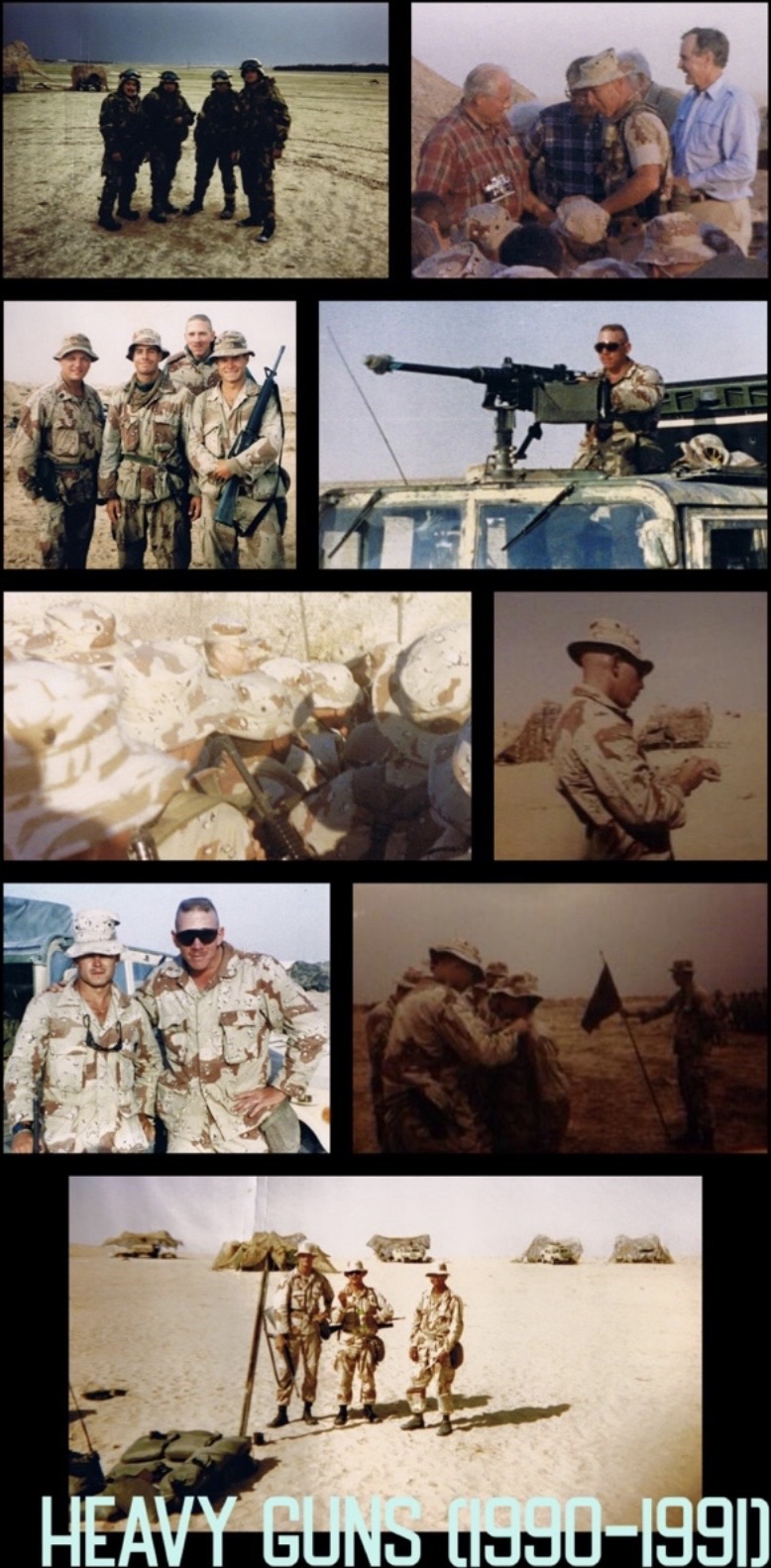
The Real Start of DESERT STORM…24 February 1991…35 years ago today!

In the predawn chill of February 24, 1991, my Heavy Machine Gun Platoon spearheaded Task Force Ripper’s advance into Kuwait, with our battalion trailing close behind. As Charlie Company urged us to slow our pace, we settled into attack positions by 0400, awaiting the signal. But chaos erupted at dawn when attached tanks mistakenly fired on friendly forces in Task Force Grizzly, killing four Marines in a direct hit on a 5-ton truck. I radioed urgently for a cease-fire, and my Marines pounded on tank hatches to halt the barrage—this was Desert Storm’s second major friendly fire tragedy, following an A-10 strike that claimed seven lives weeks earlier.
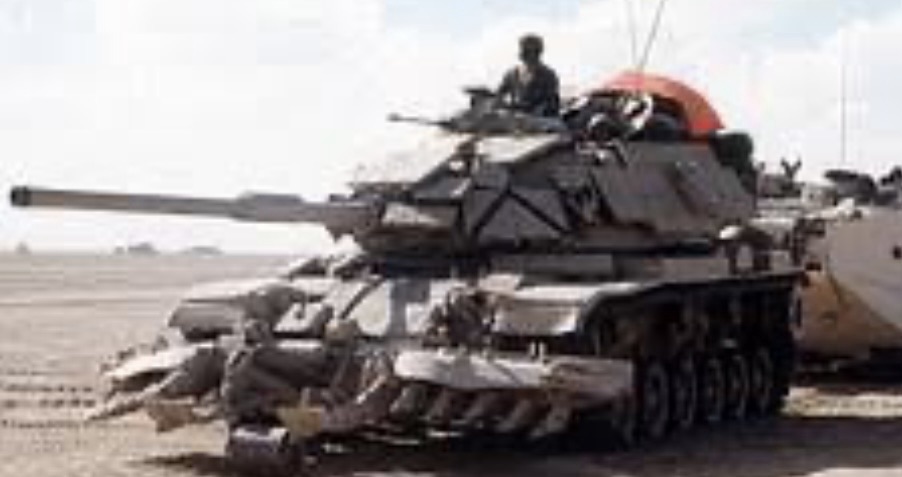
Undeterred, we pressed the assault. My platoon secured overwatch as engineers breached the first obstacle belt with MICLIC charges, plows, and rollers, punching through Saddam’s “impenetrable” defenses in under an hour amid fake plywood tanks that drew a grim chuckle. Halfway to the second belt, Iraqi artillery pinned us down during a baffling halt ordered by our commander, turning us into stationary targets. Resuming under fire, shrapnel wounded one of my gunners, but we charged on, suppressing enemy positions until white flags rose. Disarming surrendering Iraqis, we cleared crude bunkers littered with bodies and pushed toward Al Jaber Airfield.
By nightfall, after sporadic firefights, we halted amid oil well fires’ choking black smoke—zero visibility, disorienting even a short step from my Humvee. Then came the alarm: Mustard Gas detected. Donning MOPP Level 4 gear, I felt its burn on my skin, echoing WWI horrors. We endured the night sleepless, nicotine-fueled, dodging random shells, as I vowed to God for survival: Dan 2.0 emerging stronger.
This raw glimpse into ground combat’s fog reveals the valor, errors, and sheer grit of Marines in the Gulf War’s lightning offensive.

Rarely can defeat of an occupation force be accomplished solely by air power. Desert Storm required ground troops (aka: Grunts) to invade Kuwait and kick the occupying Iraqi forces out. Air power, beginning on 17 January 1991 had “softened” them up, but “boots on the ground” were required to deliver the “coup de gras.” We did, and in short order. I was the Heavy Machine Gun Platoon Commander (aka: Rat Patrol) of 1st Battalion, 5th Marines, Task Force Ripper, 1st Marine Division. Task Force Ripper was the “Main Effort” for 1st Marine Division and was comprised of two infantry battalions, moving north from Saudi Arabia into Kuwait. My battalion, 1/5, and 1st Battalion, 7th Marines, commanded by Lieutenant Colonel “Mad Dog” Mattis. I literally fought Desert Storm side-by-side with the legendary “Mad Dog” (aka: Callsign Chaos)! “Hi diddle diddle, straight up the middle!”

Here is an excerpt from my book, OUT OF AFRICA AND INTO THE CORPS:

“In the wee hours of 24 February 1991, and right on schedule, Heavy Machine Gun Platoon started moving towards our attack positions about a mile shy of the first obstacle belt with our battalion following in trace, right behind us. Charlie Company led the battalion, and several times I got a radio call from Captain Coia, their company commander. “Mustang, this is Bladerunner, over.” “Bladerunner, this is Mustang, over.” “Yeah, Mustang, you’re getting too far ahead of me, could you slow down a bit?” “Roger that, Bladerunner.” I would then inform my section leaders on my platoon’s radio net to slow down a bit. They were already tracking, because they were monitoring the battalion’s tactical net as well. It was about 0400 when we got into our attack positions and waited for the order to commence the attack. Shortly after daylight, the tank company attached to our battalion opened up fire on what they thought were enemy targets. I immediately assessed that they were firing at friendly forces. I tried to get ahold of their commander on the battalion’s tactical net. I couldn’t because he was directing fires on his company’s internal net and not monitoring the battalion tactical net. I immediately called to our battalion’s Operations Officer, Major Lockhart, to report what I suspected were the tanks firing at friendlies. “Dealer this is Mustang, over.” “Mustang, Dealer, go.” “Dealer, looks like our tanks are firing towards Task Force Grizzly.” Seconds later, Dealer makes an emergency announcement over the battalion tactical net. “Cease fire, cease fire, cease fire…all units immediately cease fire!” Unfortunately, the tank company was not monitoring the battalion tactical net, as they were on their company net, still directing fires on what they thought were enemy targets. I got on my internal platoon radio net and ordered my Marines out of their vehicles and told them to go bang on the hatches of the tanks, get their attention and tell them to “cease fire!” My Marines did as I ordered, but it still took several more minutes to get all the tanks to cease firing. They had fired several tank rounds into Task Force Grizzly’s zone, or area of operations, which was on the left flank of Task Force Ripper. One tank round was a direct hit on a Marine 5-ton truck in which four Marines of Lieutenant Max Galeai’s platoon were instantly killed and several others wounded. I could not believe that we already had casualties before even commencing the actual attack into Kuwait. It may have been worse, had not my Marines gone around to each of the tanks and told them to “cease fire.” This was the second major “friendly fire” incident of Desert Storm. First Light Armored Reconnaissance Battalion had been engaging an Iraqi force of approximately 50 tanks and armored personnel carriers south of the Kuwaiti town of al-Wafra on 29 January 1991. An A-10 Thunderbolt of the U.S. Air Force, mistaking the Marine unit for an Iraqi unit, fired a Maverick missile that struck one of our Marine Light Armored Reconnaissance Vehicles, killing seven Marines and wounding the others in the vehicle. We commenced the attack, shortly after the unfortunate friendly fire incident. My platoon moved up smartly to within two hundred meters of the first obstacle belt and established overwatch positions to provide security for our Battalion’s Engineer Detachment, led by Lieutenant Wayne Sinclair. We were taking no fire from the Iraqi side of the obstacle belt, as expected, because our intelligence analysts had assessed that all Iraqi troops had abandoned their positions on the first obstacle belt and had retreated behind the second obstacle belt, approximately ten miles to our north. We had rehearsed the obstacle belt breaching procedure numerous times in the months leading up to this moment and it went off like clockwork. The engineers brought up an Amphibious Assault Vehicle that was specially equipped to fire a mine clearing line charge (MICLIC). It is long, thin, and packed with C4 explosives. When detonated, it blows up everything in its path, creating a lane approximately eight feet wide by 350 feet in length. If there are subsurface mines, the over-pressure will detonate them down to a certain depth. The engineers had deployed a single line charge and blown it in under five minutes. They next brought up their specially built mine plough, which quickly plowed through the lane. Finally, a mine-roller went over the lane to flatten the surface and detonate any remaining mines or improvised explosive devices (IEDs). With the breaching lane cleared “hot,” I ordered two of my sections to the far side of the first obstacle belt to provide overwatch security, as the remainder of the battalion punched through. I went through with them and noted that there were a few fake Iraqi tanks on the far side along with a couple of smoldering tank hulks. The fake tanks had been built with plywood and painted to look like real tanks. They were so crude and ridiculous that I chuckled when I saw them. What Sadaam had called an “impenetrable” obstacle belt had been breached in under an hour. After our battalion was through, my platoon resumed our positions at the head of the battalion, leading the way to the second obstacle belt. We were half way there when we began to take artillery and mortar fire. Suddenly, Blackjack, the Battalion Commander ordered a halt. We became sitting ducks, and I was expecting to take direct hits any second. I called back to our Operations Officer, Dealer, to enquire as to the reason for the halt. He never responded directly, just telling me to hold in place. I could only surmise that Blackjack had gotten cold feet, after we started taking indirect fires from the Iraqi’s and decided to halt in order to figure out what to do. We all knew that halting was not the best thing to do. In fact, it was the worst thing to do. Continuing to move forward against our next objective, the second obstacle belt, was the right thing to do. Moving targets are much harder to hit than stationary targets. Finally, after what seemed like hours, but was about thirty minutes, we were ordered to resume the attack. Shortly after resuming the attack, an artillery round exploded close to Sergeant Jenkin’s Humvee. His gunner, Lance Corporal Art Windsor, who was in the turret, manning his .50 caliber machine gun, was wounded by shrapnel in his hand. I ordered Gunny Miles, our Platoon Sergeant to evacuate Lance Corporal Windsor back to the mobile Battalion Aid Station. Meanwhile, we continued to press forward as all this was taking place. As my platoon approached to within a mile of the second obstacle belt, we started taking direct fire from the Iraqi troops, manning their positions at the second obstacle belt. I ordered my platoon to open fire on enemy targets. We were firing on the move as we continued to close in on the second obstacle belt. Suddenly, my lead section spotted white flags going up from the second obstacle belt. Upon receiving the report, I ordered a “cease fire.” My guys stopped firing as we continued to approach the Iraqi positions. It turned out that the second obstacle belt was just a line of Iraqi fighting positions. The Iraqi troops were exiting their fighting positions and lining up in a formation behind them. My Marines were going through their crudely built fighting positions to ensure they were cleared. They asked me what to do with the dead bodies. I told them that we had to leave them for follow-on forces, because we were now going to be leading our battalion’s attack on our third objective, the airfield called Al Jaber, just three miles away. My guys went through the large formation of Iraqi troops to make sure they were disarmed, and I ordered them in Arabic to remain in place…that our follow-on forces would process them. My platoon then proceeded to lead our battalion to the airfield and Blade Runner was given the order by Dealer to clear the East side. Marines from 2nd Marine Division were clearing the other side of the airfield. It was dark when Charlie Company accomplished their mission with only a few sporadic fire fights at the airfield. Dealer ordered me to continue leading the march to the north. We moved away from the airfield, but then were ordered to halt, while the rest of the battalion caught up to us. Night descended on us like a thick, heavy, blanket. It was a total blackout, the likes of which I had never experienced. Thick, dark, noxious, black, oily, smoke had enveloped us. The smoke was from the oil well fires, which the Iraqi troops had started at the beginning of the air campaign. Visibility was zero. I could not see my hand six inches away from my face. At one point, I needed to take a leak and exited my Humvee to pee. I only went about ten feet from my vehicle, but when I was done, I could not see anything and became disoriented. I finally dropped down to my hands and knees and crawled in the direction of my Humvee until I bumped into it. I got back into my Humvee in time to hear from Dealer to go to MOPP Level 4…that Mustard Gas had been detected. Our battalion had a special vehicle that was equipped with sensors to detect chemical and biological substances in the environment. This vehicle had detected Mustard Gas, likely from one of the artillery rounds being fired in our direction by the Iraqi troops. After I put my gas mask on, I felt a distinct burning sensation on the back of my neck, consistent with exposure to Mustard Gas. The Germans had used it against American troops, during trench warfare in World War I. It wasn’t until two hours later that we got the “all clear” signal and were able to at least remove our gas masks. Military gas masks are very uncomfortable and make communication extremely difficult. The person who invents a gas mask that is even marginally better than the one currently used, could become a millionaire overnight, provided the military buys it. Our battalion spent the night there, but we were too hyped up to get any sleep. I was thankful to have my stash of Copenhagen. The fresh hits of nicotine keep me awake and alert. It’s hard to get any sleep when random artillery rounds are exploding nearby, and your mind is wondering if you’re going to be the next victim. I promised God that if He kept me safe, I would endeavor to be a better man for the rest of my life…Dan 2.0.”

May those who gave the ultimate sacrifice in Desert Storm “Rest in Eternal Peace.” For “all gave some, and some gave ALL!”

Semper Fi…Colonel Daniel Hunter Wilson…Retired Marine