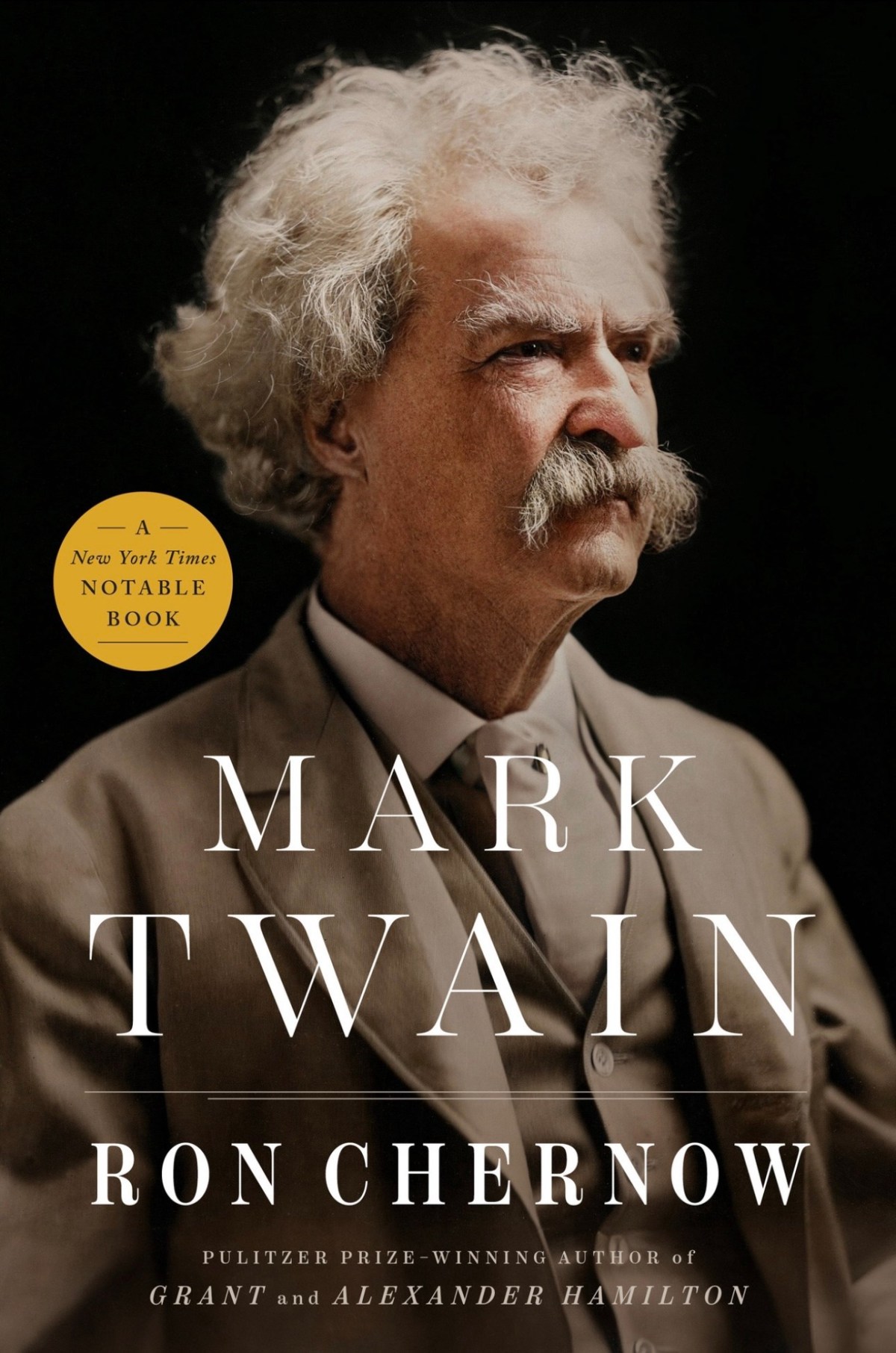
I have enjoyed reading almost all of Ron’s books, but particularly this one! In the pantheon of American literary biographies, Ron Chernow’s “Mark Twain” stands as a towering achievement—a richly detailed, profoundly insightful portrait of Samuel Langhorne Clemens, the man behind the iconic pen name. Published in 2025, this Pulitzer Prize-winning author’s latest work dives deep into the life of the writer hailed by William Faulkner as the “father of American literature.” Chernow, known for his masterful biographies of figures like Alexander Hamilton and Ulysses S. Grant, brings the same rigorous scholarship and narrative flair to Twain, resulting in a book that is as entertaining as it is enlightening.
From Twain’s humble beginnings in Hannibal, Missouri, where his boyhood adventures inspired classics like “The Adventures of Tom Sawyer” and “Adventures of Huckleberry Finn,” Chernow traces a journey marked by ambition, innovation, and no small amount of chaos. We see young Sam as a steamboat pilot on the Mississippi, a role that not only shaped his pseudonym (“Mark Twain” meaning “two fathoms deep”) but also infused his writing with the rhythms of the river and the raw pulse of frontier life. Chernow deftly explores how the Civil War disrupted this path, propelling Twain westward to Nevada, where he honed his satirical voice as a journalist, lampooning everything from politics to human folly.
What sets this biography apart is Chernow’s unflinching examination of Twain’s complexities. Far from a one-dimensional humorist, Twain emerges as a man grappling with fame’s double-edged sword: shamelessly courting celebrity while crafting a persona that masked personal vulnerabilities. Chernow delves into Twain’s financial misadventures, from disastrous investments in inventions like the Paige Compositor to his near-bankruptcy, revealing a restless entrepreneur whose optimism often bordered on recklessness. Yet, these setbacks fueled some of his sharpest works, including the biting social commentary in “The Gilded Age.”
Personal tragedies add poignant depth to Chernow’s narrative. The loss of Twain’s beloved wife, Livy, and several children is handled with sensitivity, showing how grief darkened his later years and influenced his more philosophical writings. Chernow also confronts Twain’s evolving views on race and imperialism, positioning him as a progressive voice who boldly critiqued slavery and American expansionism, even as he navigated the prejudices of his era. Drawing on thousands of letters, unpublished manuscripts, and archival treasures, Chernow paints a Twain who was both a product of 19th-century America and a prescient critic of its flaws.
At over 1,000 pages, “Mark Twain” is no light read, but Chernow’s prose flows like the Mississippi itself—propelled by Twain’s own exuberant spirit. Quotes from Twain’s letters and lectures pepper the text, bringing his irreverent humor to the fore: “The secret of getting ahead is getting started,” or his famous quip on quitting smoking (“easy—I’ve done it thousands of times”). This biography not only chronicles a life but revives it, making Twain feel as vital and relevant today as he was in his heyday.
For fans of history, literature, or simply great storytelling, Ron Chernow’s “Mark Twain” is essential reading. It reminds us why Twain’s legacy endures: his ability to hold a mirror to society with wit and wisdom. In an age of superficial fame, this book celebrates a true original who turned personal reinvention into an art form. Highly recommended—dive in and let the current carry you away! I’m sure you’ll enjoy it as much as I did!
 A 110 PERCENT MENTALITY-THE COLONEL'S CORNER